 |
| CLICK BOOK-COVER |
|
|
| Welcome To
THE ALWEG ARCHIVES
|
DON'T MISS THIS HIGHLY INTERESTING WEBSITE: TRANSPORTATION FUTURISTICS This website originally accompanied an exhibit on display at the Brown Gallery in the University of California-Berkeley Main Library (Summer 2004). Luckily this site remains available and wonderfully illustrates transportation plans, schemes and visions, - many of them from the same time that the Alweg monorail concept was successfully developed. It is noteworthy that the Alweg monorail is one of the few technical concepts illustrated on the above website that actually became reality ! |
WELCOME TO THE ALWEG ARCHIVES !
This website about the history of the ALWEG monorail system consists of an English and a German language part. The ALWEG monorail was developed in Cologne-Fuehlingen in Germany. For various reasons its potential was never recognized in its home-town or -country. In the USA and Japan however monorail technology met and meets with much greater interest. The only original Alweg monorail left in the world is still going strong in Seattle. The German language part of the ALWEG ARCHIVES contains many illustrations (captions in English also) and can be reached with this link ALWEG-BAHN .
Contents Page
| WILLKOMMEN ZU THE ALWEG ARCHIVES !
Diese Webseite über die Geschichte der ALWEG-Bahn besteht aus einem englischen und einem deutschen Teil. Die ALWEG-Bahn wurde in Köln-Fühlingen in Deutschland entwickelt. In ihrer Heimat wurde ihr Potential jedoch aus verschiedensten Gründen nicht erkannt. In den USA und Japan aber ist man der Einschienenbahn-Technologie gegenüber wesentlich aufgeschlossener. Das Interesse an "monorails" ist im englischsprachigen Raum nach wie vor groß. Noch heute verkehrt in Seattle in den USA erfolgreich die letzte Original-ALWEG-Bahn. Zum deutschsprachigen Teil der ALWEG ARCHIVES gelangen Sie über das Link ALWEG-BAHN .
Inhaltsverzeichnis
|
| Introduction to THE ALWEG ARCHIVES |
THE ALWEG MONORAIL SYSTEM is best exemplified by the Seattle Monorail. Built for the 1962 Seattle "Century 21" World's Fair this ALWEG monorail is still in service today and in the year 2000 - after 38 years - at last reached the century it presaged in the early Sixties of the Twentieth Century. As if to celebrate this achievement the Seattle ALWEG monorail has from the year 2000 on the honor to be integrated in the fantastic architectural complex of the "Experience Music Project" designed by Frank O. Gehry. Thanks to the initiative of the "EMP's" founders, Paul G. Allen and Jody Allen Patton, and Frank O. Gehry's innovative spirit the Seattle ALWEG monorail has at last arrived in its own future. ( See the EMP website www.emplive.com ) Part of the futuristic ALWEG monorail plans had always been the often illustrated possibility to let these trains also pass through buildings. Frank O. Gehry has let this vision materialize. (See photo below.) For more photos and details see the three "Seattle Pages" of the German/English appendix of these ALWEG ARCHIVES, starting with ALWEG Seattle 1962 followed by Seattle Today and then ALWEG and the EMP . Since June 18, 2004, the EMP is also the home of the Science Fiction Museum (Science Fiction Museum and Hall of Fame) adding yet another highly interesting dimension to the passage of the Alweg monorail through the EMP complex. Monorail technology in its various forms has from the earliest works of science fiction literature on always been a part of both the realistic and the phantastic worlds of science fiction. (Monorail technology is one realm of science fiction that has become reality and this is one of those stories that excellently illustrates the often futile struggle that innovative technologies face again and again in the so called modern world ... ) The Alweg monorail concept offers transit technology that is friendly to commuters and the environment. The original Alweg vision emphasizes that technology should always serve its user, - never vice versa ! And part of that vision is also city planning not for the drawing-board, but for the people who live in cities ... Daily traffic congestion demonstrates aptly that conventional city-planning has perpetuated one of science fiction's negative visions: traffic collapse. (The worldwide inability of city-planners to make positive visions come true also shows that in contrast to science fiction - considered non-serious by many planning experts - serious and scientifically accepted futurology is not fictitious ... ) This website is dedicated to the history of the ALWEG monorail system in memory of my father, ROLF KRISCHER (May 1911 - March 2000), mechanical engineer for the ALWEG FORSCHUNGGESELLSCHAFT, Germany, and its American subsidiary Wegematic Corporation from 1953 to 1967. The Seattle Monorail was his most prominent project and we lived in Seattle from 1962 to 1966. |
 |
| ALWEG mechanical engineer Rolf Krischer checking on one of the monorail trains in the "Seattle Center" ALWEG Maintenance in 1962. (Copyright Collection Reinhard Krischer) |
|
|
 |
| The Seattle Monorail and the EMP! Photographed in October 2000 by LINDSAY KORST. He perfectly captured one of the outstanding highlights of architect Frank O. Gehry's fantastic features of the EMP, - purple colored stainless steel sheets shimmering in Jimi Hendrix' "Purple Haze"! More photos by LINDSAY KORST of the Monorail and the EMP can be found on the "Seattle Today" page of the German appendix of the ALWEG ARCHIVES. With its passage through the EMP complex the original Seattle ALWEG Monorail has after 38 years arrived in an environment that it was built for in the early 1960ies for the 1962 Seattle World's Fair whose theme was "Century 21"! - Photo Copyright LINDSAY KORST. - (Mr. KORST has created a comprehensive website about the Great Northern Railway - today part of the Burlington Northern and Santa Fe Railroad - that was till the early 1970ies one of the premier railroads of the United States, famous for example for the renowned "Empire Builder" passenger train connecting Seattle with Chicago. A link to Mr. KORST's website can be found on the "Seattle Today" page.) |
|
The Alweg history is not only the story of the invention of a pathbreaking monorail system, but also the story of the sad demise of a transportation concept that was at its inception far ahead of its time.
This website is intended as an Internet Archive and is to be expanded continuously. Data contributions are always welcome; - corrections, personal impressions and information from or about former colleagues would be especially appreciated. Please contact The ALWEG ARCHIVES
Archives are usually places wherein books, documents, drawings, photos and memorabilia are preserved. Most archives store only material belonging to one specific subject. The interconnection of archives was before the Internet a tedious and lengthy process governed by the time it takes to visit and search libraries and archives or the time requests sent by snail mail take to be written and answered. The Internet with its websites and links has created the possibility to set up archives as virtual time capsules that can easily be interconnected. This "interdisciplinary linking" allows archives to give up their static status and to show that seemingly disparate fields are actually all part of a great synthesis. By also showing interconnections archives can do much more than just preserve. They can for example make learning a much more interesting and rewarding experience like those rarest of teachers who are able to instill an unsatisfied curiosity for more knowledge.
|
 |
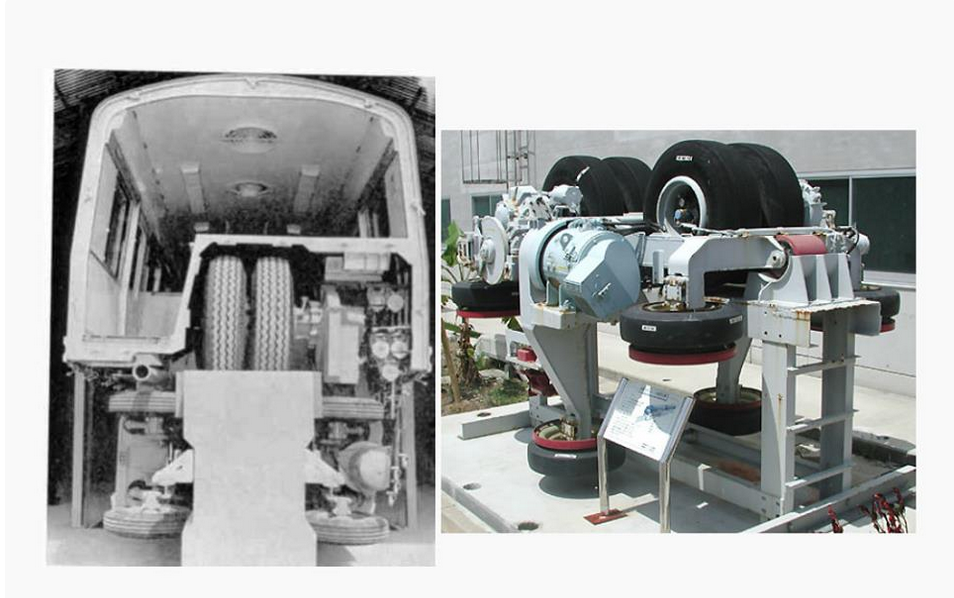
| A quickly drawn sketch concerning the Seattle Monorail side wheel suspension by Rolf Krischer. (Copyright Collection of Reinhard Krischer) |
|
| In the case of these "Alweg Archives" one of the incentives to start this site was the question what the Seattle Alweg Monorail has in common with a fantastically conceived museum of rock music, the EMP. Disparate fields indeed! The Alweg Monorail System was developed and designed in Cologne, Germany. When the EMP opened even the Cologne newspapers (and large German national papers and magazines) reported about this event. But the fact that the monorail running through the EMP complex originated in their city (and country) evaded them.
Archives also serve to prevent oblivion! |
 |
| (Reproduction of above photo with kind permission of the photo's owner, the Museum of History and Industry, Seattle) Elvis Presley, here seen in Seattle's ALWEG Monorail together with costar Vicky Tiu and dialog director Jack Mintz, rode the Monorail for his 1963 movie "It Happened At The World's Fair" (with Joan O'Brien and Yvonne Craig, all outstarred by little Vicky Tiu). When Elvis introduced the Seattle ALWEG Monorail to Rock'n'Roll no one would have believed that 37 years later the Red and the Blue ALWEG trains would still be going strong and rushing through the EMP Museum of Rock Music. Or that in the summer of the year 2000 it would be decided in Las Vegas to build a full-scale four mile long monorail system with seven stations (nine four-car trains to be delivered by Bombardier and can be seen as direct descendants of ALWEG technology). |
|
During the World's Fair in 1962 the Seattle Monorail played a small role in an Elvis Presley film. The film was not destined for Oscar nomination, but the Monorail got its first taste of Rock'n'Roll!
The EMP building complex was designed and built with the use of advanced three-dimensional computer-aided design, fabrication and building aids. Known now as CATIA these were first developed by the French Dassault aircraft company to design Mirage fighters and were adapted for commercial aircraft design by the Boeing Company.
Dr. Wenner-Gren, the Alweg Monorail's financier, was during the 1950s also a computer industry pioneer. A number of the first highly qualified Alweg engineers had previously worked in the German aircraft industry (namely Dornier, Heinkel and Messerschmitt, - engineer Rolf Krischer had worked for Dornier), closed down by Allied decree after World War II. (Which explains why the first Alweg test trains looked a bit like "airframes without wings" and why certain aluminum building techniques were favored by the Alweg specialists.)
All written and illustrative material contained in this website (including its German appendix), unless otherwise noted, Copyright Reinhard Krischer. Use and/or reproduction by permission only.
Author and Webmaster of the English and German ALWEG ARCHIVES: Reinhard Krischer
This website was established on June 23, 2000.
Last update: April 2008
No responsibility taken for contents of links given within the pages of these Alweg Archives.
|
SOURCES & ACKNOWLEDGEMENTS
The information provided by The Alweg Archives is based on the fourteen year long special personal affiliation the author has had with Alweg, on original Alweg material gathered during these years, on conversations/correspondence with and material from former Alweg employees, on a collection of German and American/British specialist literature dealing with monorail technology, on a collection of mainly German and American newspaper and magazine articles from the 1950s and 1960s dealing with Alweg and monorails in general, on extensive literature dealing with relevant transportation topics and on information generously made available by companies that once worked together with Alweg or supplied components for Alweg projects.
The author expresses his gratitude to all persons and institutions who have contributed information, material or helpful hints pointing toward possible sources. Research continues unabated. Some materials have not yet been published because they need to be complemented by still missing information or to be placed in a correct chronological order.
Thank you for all the assistance and encouragement given to The Alweg Archives! Reinhard Krischer |
|